Friday, April 29, 2011

Marking Time

Do this or you don't get paid.

That's the motivation behind a tightly defined set of tasks in CorpWorld. Sure, in a larger sense, if you don't do your daily work - you probably shouldn't get paid. But in actual fact, the only tasks where inaction could have immediate financial consequences involve documenting exactly how many hours you worked since the last time you got a paycheck.

When I used to work for the state, we had a timecard. We walked in the door, pulled the card with our name on it and stuck it into the clock. There was a satisfying *ka-chunk!* and our card went back in its holder. When you left work, you did the same thing.

And some poor schlub would collect the cards at end of two weeks, do the math, and print up everybody's checks.

Certainly not the most efficient process. With a lot of cards and manual math, it took time and was error prone. Additional time was required to audit the numbers and make sure there were no mistakes.

-But the effect on each worker was pretty modest. A few seconds each day on the way in or out

In CorpWorld, my time tracking has been brought into the modern age. Here's what I do to get paid:

At the end of each week, I:
  1. Log into a secure website
  2. Create a new timecard
  3. Type in an amount of time for each day of the week.
  4. Save the resulting timesheet to PDF
  5. Print the PDF
  6. Sign the timesheet
  7. Walk the timesheet down to my manager's office (3 floors down)
  8. Get my manager to sign it
  9. Fax a copy to an 800 number at headquarters
  10. Fax another copy to a local office
  11. Scan a copy of the signed timesheet to PDF
  12. Email the scanned timesheet to my manager

I know, you're asking - why fax and email? Because the recipients at those locations do not accept other methods. And if any of these recipients don't get what they want when they want it - my direct deposit will be delayed. I know this because one time my manager and I were out on successive days and I missed the window. Instead of a deposit in my bank accost, I received a stored value card via express mail (for the record, SVCs = sucky way to move money).

Then there's the matter of my employer knowing what I'm working on. Yes, I was here for 40 hours last week, but what did I actually do?. We have a typical (read: user-vicious) timekeeping system where I log in, and enter a breakdown of what categories of tasks I worked on each day.

Right now, I am working on a colossus of a project - so virtually all of my time goes to one of two categories: Big Project-Specific Tasks and Big Project-Administrative Tasks. The amounts I put in these categories almost never change.

Aside from those, I have two other categories Non-Big Project-Administrative Tasks and Ad hoc stuff - the amounts I can put in either of these are strictly enforced. If I go over, I will hear about it.

If I don't enter all of my time by the end of the week, I will hear about it - from multiple people. The level of granularity allows interested managerial types to look at a report and say, "this guy logs a lot of hours to the Big Project," but not a whole lot else.

Enter time tracking system number three - which I'll call Racer. Racer supports a more granular analysis of what I'm doing on the Big Project. At some point, I'm given a set of tasks - and I estimate how long each will take. At the end of each day, I'm supposed to log into Racer (which helpfully does not support single sign on- and bars the ability to remember its log in credentials. Oh, and it throws a Certificate Error because of how it's installed.). After logging in I decrease the number of hours left for each task I worked on.

So, one of my tasks is estimated at 10 hours. That day, I work on it for two hours. End of the day I log into Racer and drop the task's remaining hours to 8.

The next day, something blows up and I spend four hours working on it. Consensus is reached, but there is not a lot of progress towards the ultimate completion. I log in, and leave the number at 8. I am not allowed to update the original estimate of 10. I strongly suspect that this is not how Racer is intended to be used, but it's irrelevant in any case. The task sits at 8 because that's what is left to do.

At some point, I will be asked by a colleague on Big Project to help them with something. Were I a mindless process monkey, I would say "Give me a task in Racer, and I can help you." That is what is expected, but at the point where they are asking, it's unclear how long helping them will take. I say "Sure, I'll help." And three hours later, I've lost a good part of my day, but they have what they needed and we both feel good. But now I have to account for those hours. I have no specific task in Racer, and if I follow the rules I should ask my team leader for one.

Being me, I do. They spend ten minutes explaining how involved it would be to add another task. Technically, it will not take long, but they need approval to create a new task for me - and they're not sure they'll be able to get it approved. They say, for three hours you can probably just roll it into your existing tasks. If it's recurring work, I should get a new task. As I'm pretty sure this was a one off thing - I leave it at that.

Racer is tracking progress on three tasks for me, so I consider logging into Racer to say "nothing happened" but it will do that automatically. So I don't log in.

At the end of the week - I have worked 40 hours, and spent a little more than 2 hours logging, printing, faxing, scanning, emailing, authenticating, re-logging with greater detail, re-authenticating, re-re-logging with still greater detail.

And while I'm not at all confident that the resulting muddle of data will be an accurate reflection of what happened in the past week, I am certain of one thing:

I will get paid on time.

Friday, April 22, 2011

Sen Ensign = Gutless

(Via the NYT)
Senator John Ensign’s resignation letter allows him to leave office just one day before he was to have to answer questions under oath about whether a $96,000 payment to the family of his former lover was illegal, designed to keep the affair from becoming public, according to people familiar with an investigation of Mr. Ensign’s activities.

That formal testimony scheduled for May 4 was the final step as Senate investigators prepared for what were almost certain to be Senate ethics charges against Mr. Ensign, Republican of Nevada. Mr. Ensign’s resignation is effective May 3.
Nice.

Now how about prosecuting this guy once he leaves office, eh?

This sort of "Oh, well if you're serious - Well, then I quit" crap has got to stop.

Time Traveller? Doomed

...that is unless they know a hell of a lot about celestial mechanics.


(Via Buzzfeed)

Thursday, April 21, 2011

Mukhtaran Mai

Mukhtaran Mai, the woman who gained international respect by courageously standing up to a Pakistani tribal system that sanctions rape of innocent women and girls as punishment for the crimes of others, has once again been let down by her government.

The high court in Lahore struck down the convictions of 5 of her six attackers and commuted the death sentence of the sixth to life imprisonment.

Mukhtaran Mai now fears for her life.

Ye gods.

Monday, April 18, 2011

Two Ghosts

Recently, CorpWorld has implemented a voice mail system that is further proof that money and brains are no defense against a corporate tendency to build crap.

It’s feature rich, part of an expensive phone upgrade – and (I’m sure) was part of an elaborate focus group study.

Still, it manages to foul up the two most common tasks in voice mail.
  1. Listen to new voice mail
  2. Delete the voice mail you just listened to
All other tasks are secondary to these two items. All paths leading to these tasks should be shortened as much as possible.

Here is the path to task 1:
  1. Sit at desk.
  2. Notice flashing indicator on phone.
  3. Press Messages
  4. Enter your extension and password followed by the pound key
Right there – I have to type my extension AND my password. As extensions in CorpWord are typically long – this adds effort and opportunity to screw up before you even have to authenticate. While this may be a security/remote access feature – my extension is listed ON my phone, so removing the ability to automatically and unerringly enter the originating extension is simply a (poor and wasteful) design choice.

Then there’s the phone menu:
Welcome to voice mail for extension [my extension] -To retrieve your voice mail messages, press 1 -To send a voice message, press 4 -To manage your personal options, press 5 -To access the company private directory, press 6 -To change mail folders, press 8 -To return to the previous message, press the star key -For an operator, press zero
I’m an infrequent user (virtually nobody calls me) so I have to wait until I hear the end of the second sentence before I hit “1”
You have 1 new voice mail message. You have no saved voice mail messages.

To listen to new voice mail messages, press 1
To listen to saved voice mail messages, press 2
To listen to today’s voice mail messages only, press 3
To return to the previous message, press star
Okay. I have one new message and I’ve hit a menu item that says “retrieve your voice mail messages” A low use user like myself would like to be hearing my new message by now – but the person who is buried in messages might want the other options. Fair enough.

But reciting the option to listen to saved messages, when the system has just said there are no such messages wastes everybody’s time, no?

If I hit 1, I’m expecting my message to start playing.

Instead I get:
First message
Received
eleven
oh
four
AM
today
from
one
five
five
five
one
two
three
four
five
six
seven
And then the message finally starts playing. That’s an awful lot of dead air time before I find out if (as is often the case) this is a wrong number or misdirected call.

The system is integrated with the corporate email system, so you get an email about the message that looks like this:
Subject: VoiceMail from 0 [Company building] [unknown phone number] - 86 seconds

Body:
Directory Info
[city] [state]
Call Log
11:04:27: Initializing
11:04:27: Offering
11:04:27: [unknown system abbreviation #1]: [unknown phone number]
11:04:27: [unknown system abbreviation #2]: [unknown 5 digit number]
11:04:27: Call answered
11:04:28: [unknown 5 digit number] - [Company] Switchboard CST
11:04:28: Business Hours [hour] AM - [hour] PM
11:04:30: Switchboard Processing
11:04:30: Set Remote Name
11:04:30: [acronym] QueueName - Switchboard
11:04:30: [acronym] NoUsersAction
11:04:30: [acronym] NoUsersXferNumber
11:04:30: [acronym] UserLoggedIn - Switchboard
11:04:30: Transfer to [Company] Customer Telephone Center
11:04:34: Offering
11:04:34: Entered [unknown workgroup] Telephone Center
11:04:34: [unknown acronym] - Wait [user]
11:05:03: [unknown acronym] interaction assigned to [unknown username]
11:05:03: [unknown acronym] - Alerting: [unknown username]
11:05:03: Offering
11:05:03: Sent to user [unknown username]
11:05:03: Alerting
11:05:03: Sent to station [unknown extension]
11:05:10: Connected
11:05:10: [unknown acronym] interaction connected to [unknown username]
11:05:10: [unknown acronym] - Assigned: [unknown username]
11:05:34: Internal Transfer: [my extension]
11:05:34: Offering
11:05:34: Sent to user [my username]
11:05:34: User Alert: [my username]
11:05:34: Alerting
11:05:34: Sent to station [my extension]
11:05:54: Offering
11:05:56: Voice Mail
11:07:29: Disconnected [Remote Disconnect]
11:07:29: Caller has recorded and sent a voicemail message
Recording Length
86 seconds
[ID:[unknown ten-digit number]#[unknown phone number]

I wish to God I was making that up, but that's the actual email text, (minus necessary redactions, naturally). Assuming the caller is unknown to the system - there are three valid pieces of information in there.
  1. I have a voice mail message from [unknown number]
  2. It was recorded at 11:04 AM today
  3. It is 86 seconds long
The expanded detail of this message would include:
  1. This was an external call (or This was an internal call from [username])
The system processing notations and 37 other timestamps add precisely zero to the user's understanding of the message and can be summarized as time-wasting-bull$h!t

But back to voice mail:
Like most VM systems, this one supports keyed commands at any time in the recording.
The veteran would know to just hit 1 repeatedly until the message begins its interminably long intro (“First message…received…”).

But heaven help the poor sot who hits the 1 key too many times. Once you begin playback on the message, 1 is (naturally) a live command.

You hear

Voice mail message saved
-then nothing.

Repeating the command for the current level reveals no commands to hear saved messages.
Hitting star to go up a level repeats the prior tree only now it says you have no new messages and no saved messages.

While there may be some cryptic command to jump from new message playback to saved message playback of a just-saved message, it does not appear in the message tree and this user opted to hang up and dial back in.

As expected I was then treated to
You have no new voice mail messages. You have 1 saved voice mail message.

To listen to new voice mail messages, press 1
To listen to saved voice mail messages, press 2
To listen to today’s voice mail messages only, press 3
To return to the previous message, press star

So now the saved message is out of system limbo and is formally saved and available. Great. Also, the system spends time asking me if I want to listen to new messages when I have none.

There are so many levels of dumb going on here it's easy to miss the fact that in high-use systems with lots of users the difference between a menu saying "one new message" and "one new voice mail message" can add up to hundreds of man hours a year.

*******************

Anyway. The message from an unknown number turns out to actually be for me - and turns out to be a colleague of mine from my old job. They're putting together a reunion of sorts for one of the group who is relocating to the U.K. for three years.

Seriously cool. They are good people and it would be great to meet up with them.

I'm out at lunch thinking about how odd it will be to connect with these folks after all this time. I wonder if they'll be going to London?

-and then somebody sits down at my table.

It's H

To say that I'm surprised would be an understatement. Last I heard, H was working a new job in some other city.

They say hello and are genuinely friendly about it. Not having a good reason to do otherwise, I respond in kind. H is on the west coast now, sold their house, pulling contract work for a big name company. They just happen to be in town visiting friends. They'd been in the corner doing remote work using the store's WiFi and I'd completely missed them.

If I'd seen them first - I'd have left.

Which brings me to the whole purpose of this post, I guess. H is a person that just confounds me. My initial impressions proved wrong - my second impressions more so, and now I'm beginning to come to the realization that with people - there simply is no final word.

If you'd have asked me my opinion of H five minutes prior to meeting them that day - I'd have been negative. They were unprofessional on numerous occasions - to a degree where I actually went to management. I am glad they do not work with me for many reasons.

Five minutes later, you'd find me chatting them up and saying encouraging things about them being able to sell their house and get out alive in this market. To call this hypocrisy or reflexive make-nice is beside the point. If H has moved on and is doing well, I'm really happy for them.

But I've thought that before, too. I thought they'd found their niche at CorpWorld - before their very-public immolation. I'd even attributed sinister motives to their recruiting me for my present job - as if life was as simple and linear as TV drama.

I don't get H. They have been at least two different people since I've known them and one of them is very likeable. Generous, even. The version that popped up at my table today did something I would never have done. Walk up to a former co-worker and say howdy? I don't do that even if there isn't an awkward backstory in our collective past. The social partitions of work and home are more or less impermeable.

I do not hang out with co-workers.

I do not seek out contact with co-workers. That voicemail? They called me. I would never have done the same. Not for lack of affection, just because I view those contacts as well....done. Until they call me.

With H, its quite a bit stranger than that.

I actively tried to get this person fired once. I was a bad character witness against them when they got canned from this job. I would expect both of these facts are known to them, yet they walk up and say hi. I seem to recall getting a pinged by them on a social networking site awhile ago.

Were situations reversed, I would never do those things.

I would have flagged that person as "hostile," and written them out of my life. I had essentially done this with H - although circumstances did most of the work for me. They left, I stayed.

The occasional, accidental interaction convinces me that H's impression of me is mistaken, or that they have a very different outlook on these things. Or perhaps they thought they had no option to avoid me and made the best of it.

I do hope they are doing well. That it lasts this time.

But mostly, I wish I'd seen them first.

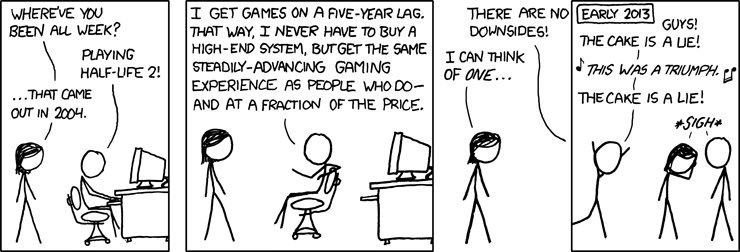
Yep, Pretty Much My Life

Although I'm singing Still Alive a year earlier than this guy - I'm still pretty sad.

Friday, April 15, 2011

The Rise and Fall of Ms. Dory Goebel

Naked Capitalism snags a great case out of the US Bankruptcy Court for the eastern district of Louisiana. In Re: Wilson. While the robo-signing phenomenon is hardly new - its violent collision with bankruptcy courts never fails to entertain.

The backstory of this case is that the debtors, Ron and LaRhonda Wilson, fell behind on their mortgage and filed for chapter 13 bankruptcy in September 2007. They entered into an agreement with the US Trustee to pay regular installments to the trustee for what they owed on their mortgage prior to declaring bankruptcy. They also agreed to continue paying all future mortgage payments directly to their lender, Option One.

Assuming all goes to plan - you would think Option One would be happy with this. The amount in arrears will be paid after a delay, but the ongoing payments will continue. A blip in the payment record, but Option One gets their money.

Option One is not happy. January 2008 they ask the court to allow them to go after the Wilsons for their money. The reason? The Wilsons haven't made the payments they promised (November 2007, December 2007, and January 2008). The Wilsons are bums, and Option One wants to foreclose.

The Wilsons counter that they have made all their payments since September, and Option One is simply wrong.

The law favors the Wilsons for one simple reason: Option One didn't supply any evidence with their motion. Motion denied.

Option One digs into their records and comes back swinging a month later. Now they claim that four payments haven't been paid - and this means the escrow may be insufficient to pay real estate taxes (the horror!). This assertion is backed up by an affidavit by Option One's new champion, Ms. Dory Goebel.
Ms Goebel affirmed:

Appearer has reviewed and is familiar with the mortgage loan account of RON WILSON, Sr. And LA RHONDA WILSON (“Mortgagor”) represented by the afore described note and mortgage and the records and data complications [sic] pertaining thereto, which business records reflect acts, events or condition made at or near the time by Dory Goebel, or from information transmitted by a person with knowledge thereof and which records and data complications [sic] are made and kept as a regular practice of the regularly conducted business activities of OPTION ONE MORTGAGE CORPORATION.
Ms. Goebel then declared that the balance due on the note was $176,063.27 and that Debtors were in default under their plan for failure to pay the monthly installments accruing from November 1, 2007, through February 1, 2008. Ms. Goebel represented that the last payment on the note was applied to the October 1, 2007 installment.
So there, sworn testimony that the Wilsons haven't been paying Option One.

By now it's April 2008. So presumably, Option One is owed these four payements and more.

But there's a problem. Six actually. The Wilsons enter into evidence copies of six payments. Western Union money orders and cashiers checks. Five of these payments have confirmation of receipt by Option One.

Oops.

The Court asks Option One's attorney - a Mr. Wirtz - to explain this discrepancy.

Wirtz discloses that his client agrees that, yes in fact, the Wilsons did make their October, November, and December payments. BUT, he claims, they still haven't paid all that they owe (presumably the January, February, and March 2008 payments), so the court should allow Option One to foreclose.

The Court reminds Mr. Wirtz and Ms. Goebel - via a show cause order - that there's still the matter of why Ms. Goebel's affidavit said the Wilsons had not paid when there was convincing evidence (including the signatures of Option One employees on certified mail receipts) for payments that Ms. Goebel has sworn did not exist.

Another hearing is held. Mr. Wirtz appears, but Ms. Goebel "was not present." Mr. Wirtz admits that the Wilsons are, his bad, current on their loan payments.

Oh, ho, ho. Silly me. Let's forget about that whole 'wanting-to-take-their-house-thing' okay, your honor? What'dya say?.
The Court jointly sanctioned Option One and Ms. Goebel $5,000.00 for failure to appear and $5,000.00 for filing a false affidavit. Option One was also ordered to pay $900.00 in attorney’s fees to Debtors’ counsel. The Court sanctioned Mr. Wirtz $1,000.00 for failing to amend the Second Motion and Default Affidavit once he obtained information which revealed that they were false.
The Court then pursued further investigation into why Ms. Goebel - working for Option One, but technically an employee of Loan Processing Services - would file a false affidavit.

I'll let the court summarize what followed:
From July 9, 2008, through December 2010, the parties conducted contentious discovery. Ten (10) motions to quash, compel, clarify, reconsider orders, stay proceedings, request protective orders; and appeal interlocutory orders were considered along with responses, oppositions and replies to each.
Finally, the court and the US Trustee pin Option One, LPS and Ms. Goebels down and get their explanation.

Ms. Goebel explains how she investigated the payment history of the Wilsons:
To execute such an affidavit, once I receive the affidavit, I will review the information that is in the affidavit with Option One’s [computer] system. So, I will validate the information based on their system and the information that is there.
Ms. Goebel is physically at LPS. So she's logging into Option One's system remotely and then comparing what she sees there with what the LPS system is telling her.

What the LPS system should have been telling her is that the Wilsons payments were being received. But the computer system doesn't say this, because LPS didn't mark the Wilson's file as a bankruptcy case until after their new payments were received. This meant payments destined for October 2007 were applied to pre-bankruptcy payments owed from June 2007. When the file was finally marked as a bankruptcy file - new payments were dropped into a general fund and the Wilsons balance was not credited. Payment was received, but it wasn't showing up on Ms. Goebel's monitor.

So.... she filed an affidavit based on what she saw on her screen. All a big misunderstanding, right? Wrong.
As part of its default services, LPS executed Affidavits of Default in support of Motions for Relief from Stay. LPS testified that it was just one of the services that LPS provided to clients. The affidavit is typical. It purports to be executed under oath before a notary and two (2) witnesses. It provides the name and title of the affiant and represents that the affiant has personal knowledge of the facts contained in the affidavit In fact, it is a sham.

...By corporate resolution, Option One grants these individuals “officer” status, but limits their authority to the signing of default affidavits. These “officers” execute 1,000 documents per day for Option One and other clients similar to the one used in this case. In fact, Ms. Goebel is an employee of LPS with little or no connection to Option One. Each day Ms. Goebel receives approximately thirty (30) documents to sign. The process of signing default affidavits is rote and elementary.

As Ms. Goebel is also a manager of a work unit at LPS, she allocates two (2) hours per day for document execution and estimates that it takes her five (5) to ten (10) minutes to sign each affidavit she receives. Before signing an affidavit, Ms. Goebel follows the procedures directed by LPS. She checks three (3) computer screens that provide the amount of the installment payment, the total balance due on the loan, and the due date for the earliest past due installment. She matches this information with that contained in the affidavit. If it is correct, she signs the document and forwards it to a notary for execution.

Although the affidavit in this case purported to verify that Option One was the holder of the note owed by Debtors through an assignment, Ms. Goebel does not personally know this to be a fact and made no effort to verify her assertion. Similarly, the affidavit identifies the mortgage and note as exhibits to the affidavit, but Ms. Goebel neither checks the attachments nor verifies that they are correct. In fact, the affidavits she signs never have any attachments when forwarded to her for execution, and she never adds any.
Well now, that's a little harsh - don't you think your honor?

Don't you think you could-?
Ms. Goebel’s training on the seriousness of her task was sorely lacking. She could not remember who “trained” her when she was promoted in 2007 to a document execution position.92 She could not remember the extent or nature of her training. 93 She did surmise that written procedures were given to her and then she began “signing.”94 She described her task as “clerical”95 and repeatedly expressed the belief that the affidavits were counsel’s affidavits, and therefore, she relied upon counsel regarding their accuracy.96 In this admission, the real problem surfaces.
But, now we know a mistake was made... Can't we just --?
Default affidavits are a lender’s representation as to the status of a loan. They are routinely accepted in both state and federal courts in lieu of live testimony. They are an accommodation to the lending community based on a belief by the courts that the facts they present are virtually unassailable. The submission of evidence by affidavit allows lenders to save countless hours and expense establishing a borrower’s default without the need for testimony from a lending representative. While they can be refuted by a borrower, too often, a debtor’s offer of alternative and conflicting facts is dismissed by those who believe that a lender’s word is more credible than that of a debtor. The deference afforded the lending community has resulted in an abuse of trust.
And there it is, yet another eloquent explanation of why robosigning is not a paperwork problem. It is a deliberate abuse of trust on the part of the lending community. Simply put - It is fraud.

The court then gives Ms. Goebel both barrels, then beats her employer over the head with the butt of the shotgun.
The abuse begins with a title. In this case, Ms. Goebel was cloaked with the position of “Assistant Secretary,” in a purposeful attempt to convey an experience level and importance beyond her actual abilities. Ms. Goebel is an earnest young woman, but with no training or experience in banking or lending. By her own account, she has rocketed through the LPS hierarchy receiving promotions at a pace of one (1) promotion per six (6) to eight (8) month period.97 Her ability to slavishly adhere to LPS’ procedures has not only been rewarded, but has assured the development of her tunnel vision. Ms. Goebel does not understand the importance of her duties, and LPS failed to provide her with the tools to question the information to which she attests....

...In this case, LPS had personal knowledge of four (4) critical facts. First, that as of February 15, 2008, Option One had received two (2) payments from Debtors in amounts sufficient to satisfy the installments due for December and January. Second, counsel had directed that the payments be sent to it rather than posted. Third, Option One alerted LPS in February that the amounts forwarded were sufficient to bring the loan current. Fourth, counsel reported to LPS that they had only received $1,846.84, a fact LPS neglected to forward to Option One. As a result of this knowledge, LPS should have known that a payment was unaccounted for between Option One and Boles. An inquiry to either might have brought the problem to light. Instead, LPS ignored the facts...

...The fraud perpetrated on the Court, Debtors, and trustee would be shocking if this Court had less experience concerning the conduct of mortgage servicers. One too many times, this Court has been witness to the shoddy practices and sloppy accountings of the mortgage service industry. With each revelation, one hopes that the bottom of the barrel has been reached and that the industry will self correct. Sadly, this does not appear to be reality....

(signed) Hon. Elizabeth W. Magner
U.S. Bankruptcy Judge

I'm thinking Bankruptcy judges should start nailing lender's pelts to the wall outside their courtroom. Maybe banks will start getting the message.

Monday, April 11, 2011

So... Which is it Ramona?

When it comes to Democratic Canvassers discussing the discovery of the Waukesha County error that swung the WI Supreme Court race back to Prosser - what a difference 4 days makes...

Ramona Kitzinger on April 7:
Everything that we went over yesterday afternoon and today, it jibed up, and we're satisfied that it's correct. And I'm with the Democratic Party, vice-chair of Waukesha County, so i'm not gonna stand here and tell you something that's incorrect.

Ramona Kitzinger on April 11:
On Thursday, I then showed up as per normal procedure at 9am and the canvass again went normally and concluded sometime between 4pm and 5pm. During the course of the day, the issue of minor vote corrections in New Berlin and Lisbon came up, but again nothing of a historic nature or reflecting glaring irregularities. In fact, the matter of vote totals in Brookfield City came up specifically during the course of Thursday s canvass. In retrospect, it seems both shocking and somewhat appalling there was no mention of discovery of this 15,000 vote human error that ultimately had the potential to tip the balance of an entire statewide election. How is this possible?

Once the canvass had been completed and the results were finalized, I was called into Kathy s office along with Pat (the Republican observer) and told of an impending 5:30pm press conference. It was at that point that I was first made aware of an error Kathy had made in Brookfield City. Kathy told us she thought she had saved the Brookfield voter information Tuesday night, but then on Wednesday she said she noticed she had not hit save. Kathy didn t offer an explanation about why she didn t mention anything prior to Thursday afternoon s canvass completion, but showed us different tapes where numbers seemed to add up, though I have no idea where the numbers were coming from. I was not told of the magnitude of this error, just that she had made one. I was then instructed that I would not say anything at the press conference, and was actually surprised when I was asked questions by reporters.

The reason I offer this explanation is that, with the enormous amount of attention this has received over the weekend, many people are offering my statements at the press conference that the numbers jibed as validation they are correct and I can vouch for their accuracy. As I told Kathy when I was called into the room I am 80 years old and I don t understand anything about computers. I don t know where the numbers Kathy was showing me ultimately came from, but they seemed to add up. I am still very, very confused about why the canvass was finalized before I was informed of the Brookfield error and it wasn t even until the press conference was happening that I learned it was this enormous mistake that could swing the whole election. I was never shown anything that would verify Kathy s statement about the missing vote, and with how events unfolded and people citing me as an authority on this now, I feel like I must speak up.
W.T.F?

Friday, April 08, 2011

Oregon Legislature Rick Rolls...Everyone?

There's all kinds of suckage in the news lately, so I'm going to just call a Friday perrogative and post something that is jaw droppingly strange.

A video of the Oregon Legislature dropping Rick Astley lyrics into the public record - with the ultimate goal of creating a Rick Roll video:

Tuesday, April 05, 2011

Götterdämmerung

So Tivo nabs me some soccer - and I speed watch my way through Chelsea humiliating themselves - then move onto the Champions League match.

Inter vs. Schalke.

Yeah, fricking Inter vs Schalke (which in German means "we're just glad to be here").

At the frickin' San Siro.

Calling Schalke the underdog is akin to calling Alan Greenspan an asshole. Sure, it's accurate, but it just doesn't seem... y'know...enough.

So, anyway I fire up the game, expecting to see Inter toy with the Germans before dispatching them 1-0. Yawn.

Sixteen seconds in, I see this sh!t:


An inexact transcript of the commentary I got on my network was.

Oh!

....WHOA!

Oh My EFFING CHRIST!!! WHAT THE SCREAMING F&*$! WAS THAT???

That would be Inter's Dejan Stanković volleying a ball from just inside the center line, over the keeper into the net - 25 seconds from kick off.

That was the opener. At this point bookies are sending out their enforcers to collect from people who had Schalke losing by only a goal. Twenty five goddamn seconds and this game is over.

Except nobody tells this to Schalke. They equalize sixteen minutes later. A total POS slob goal off a corner.

Okay, so Inter grabs another one sixteen minutes later. 2-1, Inter. Thanks for playing.

Then Edu nets just a sick goal five minutes before half. 2-2!

Then five minutes into the second half Raul scores on an even sicker move. 3-2 Schalke!

Then an own goal by Inter. 4-2. Schalke!

Four minutes later, Inter's Chivu gets sent off with a second yellow. Blood in the water. Italian fans start to eat each other...

Then Edu puts a stake into Inter with his second of the night. 5-2. Mother-effing-Schalke!

Inter...spanked. By three. At the San Siro. By Schalke!

God, but I need a drink...

Hung By Their Own PSA

(Via The Big Picture)

Barry points out another case where (wonder of wonders) a securitization trust is permanently barred from foreclosing on a house because they didn't obey the rules of their own Pooling and Servicing Agreement.

Brief explanation (as far as I understand it)

In order to turn a home loan into an investment (to securitize it), a number of things must happen:
  1. The loan must stop being owned by orginating bank
  2. The loan must start being owned by a trust, a Special Purpose Vehicle or other legal construct
  3. There must be a written record of the transfer of ownership of the loan
  4. The record of title transfer must meet the exacting specifications contained in a document called a Pooling and Servicing Agreement, typically they require that all the documents establishing transfer of the mortage note be completed within 60-90 days.

Why all this rigamarole?
Two big reasons are who owns the loan and taxes.

In order for an investor to invest in a security, they want to know that the thing the are investing in is truly theirs. In theory, if the home loan goes bad - they want to know that at least they will get the property in a foreclosure. If an investor knows that there are other entities that could claim to own the home loan - then their back up plan of foreclosure is now worth less, (and may be impossible). If the bank who made the original loan doesn't provide documentation that it no longer has any right to a home loan - there is a chance that that bank could show up and demand a share of the the loan's value (or of the resulting foreclosure).

Now taxes:
The SPV allows ownership of the loan by a trust without subjecting its payments or distributions to investors to taxation. This is a big deal because if the money passing through an SPV was taxed - it would make mortgage backed securites much less attractive as investments because investors would see their money taxed twice. Once as the money flows through the SPV and then again as the investors get paid. This is an intentional loophole, as the SPV is just a pass-through legal construct, it takes no profits - it just passes along the payments it gets.

The price of getting this nice loophole is complying with a very strict agreement called a Pooling and Servicing Agreement. If you don't comply with the PSA bad things can happen. Like, the tax rate on money going through the SPV goes from 0% to 100%

Investors will hate that with the heat of a nova.

And when home loans go bad - and the SPV moves to foreclose they had better have a chain of ownership that shows that they own the loan in question.

Otherwise something like this Alabama ruling will happen - Phyllis Horace vs. LaSalle Bank National Association et. el.:
Following hearing and review of all submissions from the parties the Court has come to two conclusions necessary for the disposition of this case:

First, the Court is surprised to the point of astonishment that the defendant trust (LaSalle Bank National Association) did not comply with the terms of its own Pooling and Servicing Agreement and further did not comply with New York Law in attempting to obtain assignment of plaintiff Horace's note and mortgage.

Second, plaintiff Horace is a third party beneficiary of the Pooling and Servicing Agreement created by the defendant trust (LaSalle Bank National Association). Indeed without such Pooling and Servicing Agreements, plaintiff Horace and other mortgagors similarly situated would never have been able to obtain financing.

Consequently, plaintiff's motion for summary judgement is granted to the extent that defendant trust (LaSalle Bank National Association) is permanently enjoined from foreclosing on the property...
...Further, the Court is of the opinion there is no reason for further delay as to the entry of final judgment concerning the issue of foreclosure by the trust (LaSalle Bank National Association).

That notice shall issue to the parties.
DONE this the 25th day of March, 2011.

ALBERT L. JOHNSON, CIRCUIT JUDGE
Counsel for the investors...start your engines! You will be suing the bejeezus out of LaSalle Bank National Association et. el., because the secured loans you invested in are unsecured because the trust can't prove they own the loans.

Also, your client's pass-through tax exemption is at risk. Huzzah!


LaSalle says they will appeal - although they'd better confine it to the bit about the plaintiff being ruled a third party beneficiary of the PSA, because they look seriously owned on any argument that they met their PSA obligations.

If you believe Barry and the crew, there are many, many loans out there in the same condition as this one just waiting for an enterprising attorney to detonate them.

I'll quote Barry from an earlier post of his:
Understand this precisely: This was not a case of slipshod handling, of sloppy paperwork, or bad management. This was a willful decision to break the law in order to save expenses and be more profitable.

The bank's PR machine can play whack-a-mole, but these cases are going to bubble out all over the place. They can't appeal all of them, and by rights they should lose most of them.

When does this mess reach critical mass?

Monday, April 04, 2011

Portrait of a Beatdown

Lest you think I was exaggerating in my prior post - here's some of the relevant court transcript from HSBC Bank USA, NA as Trustee for Nomura AAC vs Orlando Eslava.

Yves calls it "a doozy."

I call it art. Some artists work in clay, some work in oils, Miami-Dade County Circuit Judge Jennifer Bailey works her magic in righteous indignation. Unlike the rest of us, Judge Bailey is empowered to act on her indignation.

By way of prologue HSBC Bank has previously been ordered by the court to post a bond to indemnify the defendant - whose house they have foreclosed on despite not having the mortgage note that establishes that the house is rightfully theirs. The deadline has passed without the bond being posted. The court is not amused.

HSBC Bank is represented by a Mr. William Huffman, the Florida Default Group by Ms. Suzanne Hill, and the (reserved and presumably gleeful) attorney for the defendant, Orlando Eslava is a Ms. Sheleen Kahn.

The curtain rises
THE COURT: And so then you know what you do? You file - if you have a problem with the court order and you get inconsistent directions from your client, you file a motion for extension of the time to file the bond, you come forth and say to the Court the case is in loss mit[igation] hold, can we postpone the filing of the bond? Can we give up the sale date so that I can give it to somebody else who really needs to sell ap piece of property on the courthouse steps? Instead of just ignoring a court order, because that's what happened here.

MS HILL: I don't disagree that it could have been handled much better. I do agree to that.

THE COURT: I appreciate your diplomatic response, but is there any reason why the Court should not issue sanctions in this case? I mean, the court order was simply, based on what you're telling me, ignored because the client took the file in loss mit[igation] hold.

MS. HILL:
Well, it was not complied with, that is correct, your Honor. And it was because it was on hold.
     And Mr. Huffman honestly believed that if the case was still on hold, he had no objection to having the case dismissed.
     As far as opposition at that hearing, Mr. Huffman believed he conveyed instructions to the local counsel that the case was on hold and there was no opposition.
     I can't speak to what was said at that hearing --

THE COURT:
Let me just be clear. I'm not going to sanction Mr. Huffman. Mr. Huffman, you know, he's just doing what the e-mails tell him to do. I know that.
     At some level there is responsibility on the part of this court to make sure that notwithstanding whatever kind of sloppy operation the plaintiff is running, that court orders are complied with.
     And Mr. Huffman, at the end of the day, this trust is going to be over and at the end of the day some day this foreclosure crisis is going to be over. And you need to decide what kind of lawyer you're going to be. Because at the end of the day you're responsible for your client's compliance with court orders.
     And saying, oh, well, my client told me this, is not a defensible position because you swore an oath to follow the Rules of Civil Procedure and to follow the rule of law. And at the end of the day when they bury you, the words "HSBC Bank USA, NA as Trustee for Nomura Asset Acceptance Corporation, Mortgage Pass-through Certificates Series 2006--ARI will probably appear nowhere in your obituary.
     So, you know, the bottom line - and I'm not giving you a lecture that I am not routinely delivering to foreclosure lawyers at this point in my career, which is, all lawyers have is your reputations. We don't make widgets, we don't buil[d] clocks, we don't build cars. We have nothing but the pleadings we file and sign our name to to evidence the quality and integrity of who we are.
     And when you get a court order that says post a bond -- and you're being required to post a bond for a very logical reason. It's a trust. It's going to expire by its terms.
It's not the Bank of America. I don't know if it's going to be there in six years. And you've lost the note and you're required to indemnify the defendant and therefore you have to post a bond.
     When that order is simply ignored and further motions for clarifications with the Court are not sought, you know, yes, do I understand completely that this is the client not knowing the left hand from the right had, yes; but at the end of the day, you're the lawyer, you're responsible.

MR. HUFFMAN:
Yes, your Honor.

THE COURT:
How many people currently work in your office?

MR. HUFFMAN:
Attorneys or --

THE COURT:
Attorneys.

MR. HUFFMAN:
Fifty.

THE COURT:
How many files are you currently responsible for?

MR. HUFFMAN:
I don't have that number. I'm not sure.

THE COURT:
How many cases can you tell me you know anything in detail about the loss mitigation status of the file?

MR. HUFFMAN:
Well, the way it's set up, the bank handles the loss mitigation separately.

THE COURT:
So the answer is zero. You're filing pleadings in court every day and you don't even know what's going on with the case.
     And see, the really interesting thing to me as a judge is that in no other species or kind of law would that be remotely acceptable or, frankly, anything short of malpractice. But somehow in Foreclosure World everybody things that that's just fine, that you can know absolutely nothing about your files and walk in here and ask judges for things left and right without even knowing what's going on.
     And, you know, ultimately, the law firms are going to start doing that at their [peril].

[........]

THE COURT:
...And I'm not trying to crucify Mr. Huffman just because he happens to be the guy that I hauled in here today, but the upshot of it is the bond was not posted. How much was the amount of the final judgment?

MS KHAN:
Judge, if I may look in the file?

MS HILL:
[$]207,238.72

THE COURT:
Did the plaintiff acquire title [to Mr.Eslava's house] at [the foreclosure ] sale?

MS. HILL:
Yes, your Honor.

THE COURT:
What's the status of the property? Does anybody know?

MS. KAHN:
Your Honor, Sheleen Khan for the defendant.
The defendant is paying on direct debit from his account every month. This will be his fifth payment under the HAMP program, your Honor.

THE COURT:
Okay. I think as a sanction what would be appropriate is to direct HSBC, who failed to comply with the Court's order, the only -- there's nobody here from HSBC to offer any --

MS. HILL:
Well, Mr. Huffman is here on behalf of HSBC today, as well.

THE COURT:
But he doesn't know anything about the loss mitigation status. I just asked him.

MS. HILL:
It's our understanding in this case that it is still under loss mitigation, it is being reviewed by HAMP for permanent modification.

THE COURT:
Mr. Huffman, please rais your right hand.

(Thereupon, William Ward Huffman, III Esq. was duly sworn by the Court.)

THE COURT:
What's your name?

MR. HUFFMAN:
Bill Huffman.

THE COURT:
What was the loss mitigation status on March 4, 2010?

MR. HUFFMAN:
It was on hold for --

THE COURT:
Tell me what was going on. How much had the defendant paid in? Had the defendant made any HAMP payments? Was the defendant formally enrolled in a HAMP program? Was the defendant in a HAMP trial period for HAMP?

MR. HUFFMAN:
I knew the defendant was in a trial period for HAMP.

THE COURT:
When was the defendant put into a trial period for HAMP?

MR. HUFFMAN:
My file went on hold November 6 of 2009, so I knew they had been in the trial period since that time. I didn't know the exact date.

THE COURT:
December what?

MR. HUFFMAN:
It was November 6, I believe, 2009.

THE COURT:
What was the date of the final judgment? December 9, 2009.

MR. HUFFMAN:
The hearing was, I believe, November 5 and the judgment was signed December 9.

THE COURT:
So you have a final judgment hearing on November 5 and the file went on hold November 6?

MR. HUFFMAN:
Correct.

THE COURT:
When was the file HAMP approved?

MR. HUFFMAN:
It hasn't been fully approved at this time.

THE COURT:
When was the file HAMP approved for trial modification?

MR. HUFFMAN:
From my knowledge, it was November 6.

THE COURT:
But I'm not asking you about your knowledge. Because you're here to testify on behalf of your client.

MR. HUFFMAN:
Okay.

THE COURT:
So on behalf of HSBC Bank USA, NA as Trustees for Nomura Asset Acceptance Corporation, Mortgage Pass-through Certificates Series 2006-ARI, when was Mr. Eslava's HAMP documentation accepted?

MR. HUFFMAN:
I don't have -- I didn't see the doc to see when he actually signed the preliminary mods. I don't know the exact date. I just know that I was notified on November 6 to place my file on hold.

THE COURT:
Mr. Huffman, respectfully, can't answer the questions I have because --
I'm going to sanction the bank. I'm not going to sanction Mr. Huffman. I could because I think Mr. Hoffman's conduct was contemptuous of a court order. But I'm also keenly aware that a comtempt finding from a judge has ramifications throughout the rest fo a laywer's career, and I'm really trying to avoid that.
     What I'm trying to give is, for lawyers that handle these cases, a wake-up call to say this is your life, this is your career on the hook and you guys better wake up and smell the coffee.
     But he cannot answer the questions for me to tell me the nature of the contempt.
Why wasn't a bond posted in this case pursuant to the court order?

MR. HUFFMAN:
When I saw the order from March 4, I kind of read it --

THE COURT:
Why wasn't the order -- the bond was ordered posted -- when did I order the bond? March 4. Okay.
Why wasn't a bond posted by April 4?

MR. HUFFMAN:
When I saw the language, I thought it had two options, either post the bond by April 4 or have the case dismissed. Because our file was still on hold April 4, I just chose to allow the case to be dismissed.
     Instead of posting the bond, I though that was an option I had. I thought it would be in the best interest of all parties. I didn't want to incur any more fees for the defendant in this case by moving the case forward.

THE COURT:
Okay. Then as a sanction, the Court will follow the path chosen by Mr. Huffman. I will dismiss the case. I will dismiss the case with prejudice.
The note, which was canceled by this Court pursuant to a final judgment is null and void.    
     Mr. Eslava is relieved of the debt.

     The title shall be conveyed back to Mr. Eslava by the bank -- by the trust -- as the legal liability for the note no longer exists.
     The basis for this sanction is the contemptuous noncompliance with the Court's order to post the bond.
     Should, however, any claim ever be pursued against Mr. Eslava on the note which was the subject of this case, since the note was lost, HSBC Bank USA, NA, as Trustee for Nomura Asset Acceptance Corporation, Mortage Pass-through Certificates Series 2006-ARI shall jointly and liablely (sic) with Florida Default Law Group, PL, and any successor law firm, be responsible to hold harmless and indemnify Mr. Eslava from any liability should the orginal appear in the context of another case.

MS. HILL:
Your Honor, if I may just briefly respond?
     I believe under the case law that in order to award sanctions, there has to be a finding of willfullness and bad faith on the part of Mr. Huffman.

THE COURT:
No, this is on behalf of HSBC. I'm finding wilfulness because -- I'm not making Mr. Huffman responsible for the $207,238.72. I'm saying HSBC has been offered an opportunity to come and testify to this Court about why all this confusion erupted. They have given me Mr. Huffman. Mr. Huffman respectfully, can't answer very many of my questions in detail because all he knows is that the file was put on hold. It was put on hold the day after a final judgment was entered at the behest of the bank.
     Now, I would like to know why the bank came in here one day to get a final judgment and the next day to put a file on hold. But that's really a sideshow. Really the big question is why didn't they comply with the order of March 9? Why did they simply ignore it.
     And that answer is ["]we put the file on hold["]. That's a contemptuous answer. A bank does not have the authority or a trust does not have the authority to ignore a court order simploy because they are making business decisions on a file. And that's really where we are at.

MS. HILL:
Respectfully, I understand, your Honor.
     In this case, Florida Default Law Group is taking responsibility for its actions. And I would respectfully submit that canceling the underlying indebtedness woudl not seem to fit the failure of Florida Default in this case on behalf of the bank in complying with the order. Florida Default is more than willing to stand before you and apologize.

THE COURT:
No. No. No. This is way beyond -- you know, look, I don't want apologies. I want performance. I want responsible attorneys who meet the basic standards of knowing what the Sam Hill is going on in their files.
     I want acknowledgment that says, look, we understand that the court system is facing a massive number of foreclosures and we are not going to contribute to that burden by causing useless work by the Court.
     Which is really what I just got told.
What I got told is, Judge, the guy was already approved for HAMP by November 6, so the hearing on November 5, you really didn't need to do that.
     Because for every hearing that I do on these cases, the reason why I get this packet is I check service on every defendant, I look at the note, I make sure there's an endorsement. The fastest I can do one of these is about seven minutes. The slowest I can do it, if it's out of order, if it's disorganized, if there's things missing, which may well be the case in this case because the hearing was November 5 and the order wasn't entered until December, which means that there may have been missing items, it can take as much as 15 minutes or a half an hour. So the bank wasted my time on that.
     They wasted my time -- and I don't care about my time because I'm paid the enormously high sum of $144,000 to be here every day.
     But the second waste of time was then they come in and opposed the defendant's motion to cancel the sale. And we had a hearing and we talked about that. An I would imagine that took somewhere between 12 to 17 minutes, depending on how it went.
     And then they come in and walk in a motion to cancel the sale.
That's three useless, completely idiotic events. And if Florida Default wants to make HSBC whole in this, then that's between them and their carrier.
     But the bottom line is that's the sanction that the Court has ordered. Mortgage foreclosure is an quitable remedy. The plaintiff in this instance, whether it's through its own conduct -- because, frankly, I can't -- what Florida Default is telling me is we're just doing what they're telling us to do. They told us to put a file on hold.
     If this is how a bank is going to conduct its business, then the bank should be bearing the sanctions. Florida Default can cut whatever deal it wants to cut with them, but at the end of the day, the bank is responsible for this.
     Thank You.

MS. HILL:
Thank you, your Honor.

THE COURT:
I need the transcript ordered, please, and a simple order attached that adopts the transcript as my order, because I think that's going to be the cleanest way to do that. And I will direct that the transfer of title occur within 30 days.
Then the attorney for the defense realizes this is her moment.
MS. KAHN: Your Honor, if I may add, I have an affidavit in support of fees, attorneys fees, reasonable fees.

THE COURT:
How much?

MS. KAHN:
[$]1,222, your Honor. 6.11 hours.
To the surprise of no one, Ms. Kahn gets her money.

Fade to black.

Fin.

Hit Them Where Their Heart Would Be, If They Had One

(Via Naked Capitalism)

Short version:
  • Foreclosure mill moves against homeowner.
  • Foreclosure mill is forced to admit to a bankruptcy judge that they are moving to foreclose, sans paperwork.
  • Bankruptcy judge puts her foot in said mill's ass so hard, they're spitting up shoe leather.
A thing of beauty from any angle, but really, read the whole account. I'm focusing on the 2010 case before Judge Bailey, but a more recent case is what Yves is trying to track down. As in Have judges finally starting giving out free houses to address clear instances of foreclosure fraud?

Stay tuned.